
Imagine that your company has purchased a custom-designed industrial pump system.
After months of engineering, manufacturing and supplier follow-up, the equipment finally arrives at the factory. It looks exactly as expected, and the supplier confirms that the order has been delivered.
But when the Engineering team prepares for installation, several important documents are missing.
The final drawings have not been submitted. The installation instructions are incomplete. Quality cannot locate the agreed test reports, and Maintenance has not received the spare parts list or operating manual.
The equipment is physically present, but the organization cannot yet confirm everything necessary to install, start, operate and maintain it.
This illustrates an important principle in Engineer-to-Order procurement: the physical product is not always the complete delivery.
For customized equipment, engineering documentation, test evidence, technical instructions and final manufacturing records can be just as important as the equipment itself.
This article explains why supplier documentation matters, introduces important terminology such as Vendor Document List (VDL), Master Document Register (MDR) and Manufacturing Record Book (MRB), and connects documentation management to the responsibilities of operative and tactical buyers.
The objective is to help buyers manage the total supplier delivery, not only the arrival of the physical equipment.
LHTS Procurement Framework
- Primary procurement role: Operative Procurement
- Supporting role: Tactical Procurement
- Procurement process: Requirement definition, RFQ, contracting, purchase order execution, supplier follow-up, technical verification, commissioning and final handover
- Learning level: Basic
- Related online course: Managing Engineering Change by Dave Barr
Quick Answer: Why Is Documentation Part of an Engineer-to-Order Delivery?
Engineer-to-Order (ETO) is a manufacturing approach in which a product is specifically engineered or substantially adapted to meet a customer’s requirements.
When purchasing ETO equipment, the complete contractual delivery may include much more than the physical product.
The supplier may also be required to deliver documentation allowing the customer to:
- Verify that the design meets the agreed requirements.
- Confirm that manufacturing and testing were performed correctly.
- Prepare for installation.
- Commission and start the equipment.
- Operate the equipment safely and effectively.
- Maintain, repair and modify the equipment throughout its useful life.
These documentation requirements must be defined in the contract and managed throughout the supplier delivery process.
A professionally managed ETO purchase follows the complete delivery: equipment, information, evidence and agreed technical support.
Who Needs Supplier Documentation, and Why?
Supplier documentation is not created only for the purchasing department.
Different functions within the buying organization depend on different information.
Engineering – To Verify the Design
Engineering needs sufficient information to establish whether the supplier’s design meets the technical specification.
This may include drawings, calculations, performance data, material specifications and interface information.
For example, an Engineering team purchasing a new pump system needs to verify that the equipment fits the installation, provides the required performance and is compatible with the existing process.
Without the necessary engineering documentation, technical verification may be incomplete.
Quality – To Verify Conformity
Quality needs evidence that the equipment has been manufactured, inspected and tested according to the agreed requirements.
Typical documents include material certificates, inspection reports, welding records and test results.
The purpose is not simply to collect certificates. The documentation provides evidence supporting the required quality and release decisions.
Installation and Commissioning – To Prepare and Start the Equipment
Installation and commissioning teams need information about dimensions, lifting requirements, connections, electrical interfaces, installation procedures, testing and startup activities.
For example, a customized machine may be delivered physically complete but still require alignment, utility connections, control-system configuration and commissioning tests.
The required documentation helps the organization prepare and perform these activities.
Operations – To Use the Equipment
The Operations team needs instructions describing how the equipment should be operated, monitored and controlled.
This may include operating limits, control-system information, operating sequences, alarm descriptions and safety instructions.
Without reliable operating documentation, the organization risks using the equipment incorrectly or outside its intended operating conditions.
Maintenance – To Maintain and Repair the Equipment
Maintenance needs information that supports long-term equipment reliability.
Typical examples include spare parts lists, maintenance instructions, electrical diagrams, lubrication requirements, equipment settings and troubleshooting guidance.
This information may be needed many years after the original purchase.
Procurement – To Control the Supplier’s Complete Delivery
Procurement connects these requirements to the supplier’s contractual obligations.
The buyer needs to ensure that the required documentation has been specified, priced, scheduled and included in the supplier’s delivery commitments.
During execution, the buyer follows up the documentation alongside manufacturing and physical delivery.
The buyer does not normally approve engineering calculations or inspection results. Those decisions belong to the responsible technical functions.
However, Procurement helps ensure that the required information is delivered at the right time and that unresolved documentation issues are visible.
What Makes Engineer-to-Order Different?
In standard purchasing, the product design is normally already established.
The buyer orders a defined product against an existing specification.
In Engineer-to-Order, the supplier must carry out engineering activities specifically for the purchase.
This may include designing a completely new product or adapting an existing technical solution to meet the customer’s requirements.
Typical ETO purchases include:
- Customized manufacturing equipment.
- Industrial pump systems.
- Heat exchangers.
- Automation systems.
- Electrical control systems.
- Process equipment.
- Pressure vessels.
- Special-purpose machinery.
- Customized material handling systems.
The supplier may not have a complete manufacturing design when the purchase order is placed.
Engineering activities become part of the delivery process, often with their own review and approval milestones.
Consequently, the buyer may need to monitor several parallel commitments:
- Engineering progress.
- Technical documentation submissions.
- Manufacturing progress.
- Inspection and testing.
- Physical equipment delivery.
- Installation and commissioning support.
- Final documentation and handover.
The required scope depends on the contract. Not every ETO order includes installation or commissioning services, but the documentation needed to support those activities may still be part of the supplier’s delivery.
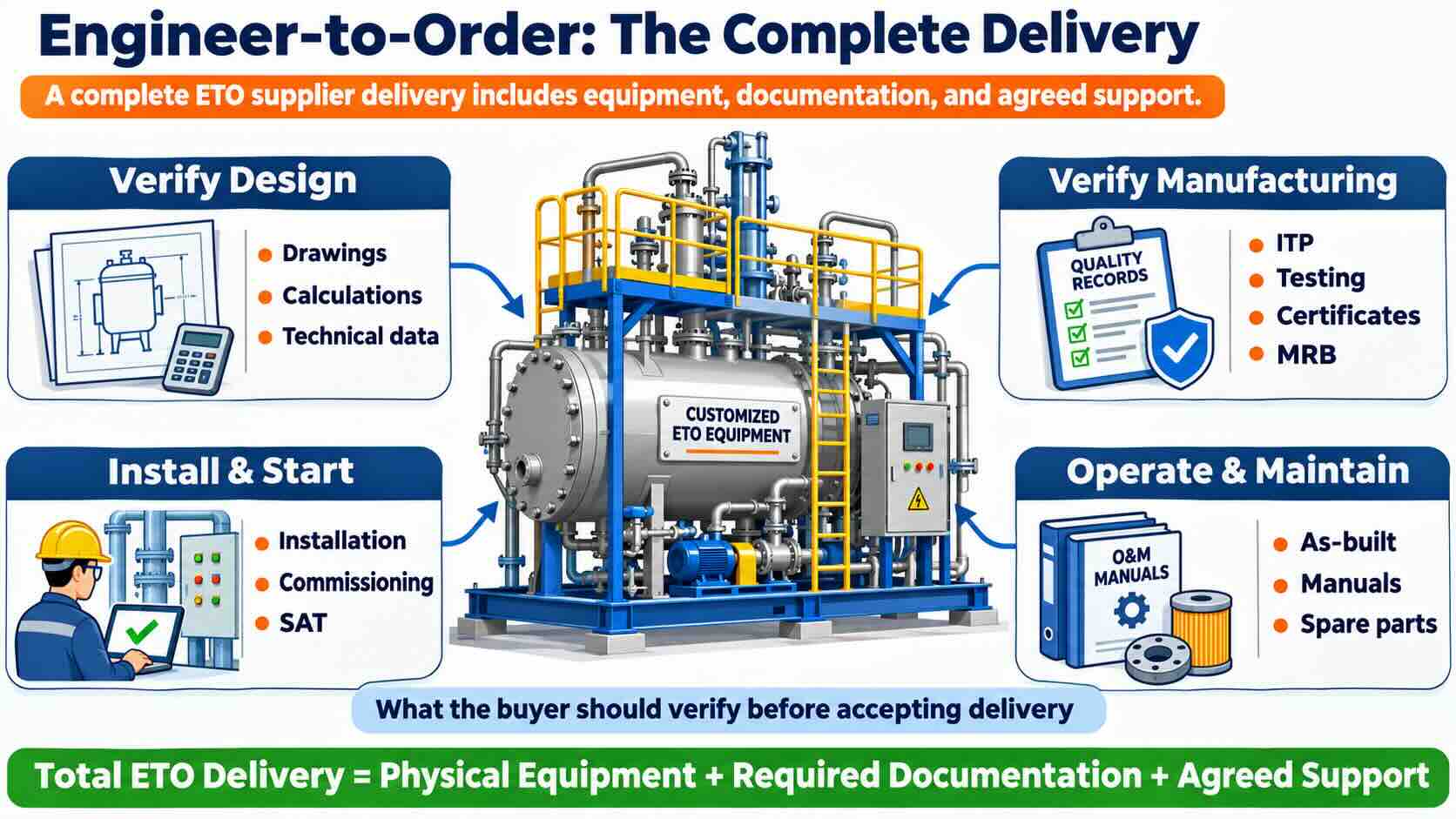
The Four Purposes of ETO Documentation
A useful way to understand supplier documentation is to organize it according to what the buying organization needs to accomplish.
This is a practical LHTS learning model, not a universal industry documentation classification.
1. Documentation to Verify the Design
Before manufacturing or installation, the buying organization may need to review the supplier’s proposed design.
Typical documents include:
- General arrangement drawings.
- Technical data sheets.
- Engineering calculations.
- Piping and Instrumentation Diagrams (P&IDs).
- Electrical schematics.
- Interface drawings.
- Equipment layouts.
- Functional descriptions.
These documents allow Engineering to check whether the supplier’s solution meets the specification.
Some documents may be required before manufacturing can proceed.
The buyer needs to understand which submissions are linked to agreed design-review or manufacturing-release milestones.
2. Documentation to Verify Manufacturing and Testing
The supplier may be required to demonstrate that the equipment was manufactured and tested according to the approved requirements.
Typical documents include:
- Inspection and Test Plans (ITPs).
- Material certificates.
- Welding records.
- Non-Destructive Examination (NDE) reports.
- Dimensional inspection reports.
- Calibration certificates.
- Factory Acceptance Test (FAT) reports.
- Nonconformity reports and approved dispositions.
- Certificates of Conformity.
These documents provide evidence about the manufactured equipment.
The required evidence should reflect the technical specification, applicable standards and purchasing contract.
3. Documentation to Install and Commission the Equipment
Before the equipment can be put into operation, the installation and commissioning teams may need:
- Installation drawings.
- Foundation and interface requirements.
- Lifting and handling instructions.
- Connection diagrams.
- Electrical and control-system documentation.
- Installation procedures.
- Commissioning procedures.
- Startup instructions.
- Site Acceptance Test (SAT) procedures.
- Safety-related instructions.
Some information may need to be delivered well before the equipment arrives, so that the receiving site can prepare.
Late submission can delay installation even when the physical equipment arrives on time.
4. Documentation to Operate and Maintain the Equipment
The final documentation package supports the equipment throughout its operating life.
Typical documents include:
- Final as-built drawings.
- Operating manuals.
- Maintenance manuals.
- Spare parts lists.
- Equipment and component identification.
- Recommended maintenance intervals.
- Troubleshooting instructions.
- Electrical and control-system diagrams.
- Approved software or configuration information, where required.
- Final test and conformity records.
This documentation may be transferred to Operations, Maintenance, Engineering or the organization’s technical asset-management system.
The required delivery formats, usage rights, access arrangements and document revisions should be agreed.
A useful principle is that the buyer should consider not only whether documents exist, but whether the receiving organization can actually use them.
Is There an International Standard for ETO Documentation Packages?
There is no single universal document package, terminology system or checklist that defines every ETO delivery.
Different companies, industries and markets use different approaches.
A manufacturer of customized packaging machinery may use a relatively simple documentation list.
An offshore equipment supplier may require extensive inspection records, material traceability, manufacturing documentation and formal approval processes.
An aerospace supplier may follow additional industry-specific quality and configuration requirements.
An automation supplier may concentrate on electrical documentation, software, functional testing and commissioning records.
The correct approach depends on:
- Industry and market requirements.
- Product complexity.
- Technical and safety risks.
- Customer specifications.
- Applicable laws and standards.
- Company document-management procedures.
- Contractual responsibilities.
- Equipment lifecycle requirements.
Standards Still Play an Important Role
Although there is no universal ETO documentation package, international standards cover important parts of documentation management.
Examples include:
ISO 10007 – Guidelines for Configuration Management
Provides guidance on managing product and service configuration information, including identification, change control and traceability.
IEC/IEEE 82079-1 – Information for Use
Provides general requirements and principles for preparing product instructions and information needed by users.
ISO 20607 – Machinery Instruction Handbook
Addresses safety-related information in instruction handbooks for machinery.
IEC 62381 – Factory and Site Acceptance Testing
Addresses FAT, SAT and related testing activities for automation systems in the process industry.
These standards do not establish one universal supplier documentation list.
Instead, they provide requirements or guidance for particular activities and documentation subjects.
The actual applicability must be established for each purchase.
Why Company-Specific Procedures Matter
Large industrial companies frequently establish their own supplier-documentation procedures.
These may define:
- Required document types.
- Document numbering.
- Revision rules.
- Submission schedules.
- Review procedures.
- File formats.
- Document status codes.
- Approval responsibilities.
- Final documentation requirements.
Such procedures can become contractual requirements when properly included or referenced in the purchasing agreement.
This is why buyers must work with the applicable document procedure rather than assume that a method used in one project automatically applies to another.
Key Terms in Supplier Documentation Management
Several abbreviations are frequently encountered in industrial procurement.
Their exact definitions and application can vary, so the relevant company or project procedure should always be checked.
VDL – Vendor Document List
A Vendor Document List identifies or tracks technical documentation that a supplier must submit.
It may cover engineering drawings, data sheets, calculations and other agreed deliverables.
Baker Hughes provides a real industrial example of a VDL used in connection with purchase specifications and engineering-document submissions.
The supplier submits the list through a defined process before submitting the required design documents for review.
VDRL – Vendor Document Requirements List
A Vendor Document Requirements List defines documentation requirements for the supplier.
It may specify:
- Document descriptions.
- Document numbers.
- Required submission dates.
- Submission purposes.
- Review responsibilities.
- Required formats.
- Final handover requirements.
The VDRL helps establish documentation expectations before the supplier begins executing the order.
SDRL – Supplier Document Requirements List
A Supplier Document Requirements List serves a similar purpose.
TechnipFMC provides an example where an SDRL communicates pre-manufacturing and post-manufacturing document requirements for certain purchase orders.
MDR – Master Document Register
A Master Document Register is used to control and monitor documentation.
It provides visibility of the documents required, their revisions, submission dates and review status.
A register may include the responsible supplier contact, customer reviewer and outstanding comments.
Some companies use the term Supplier Master Document Register (SMDR).
MRB – Manufacturing Record Book
A Manufacturing Record Book is a structured collection of manufacturing and quality records associated with the delivered equipment or components.
Depending on the applicable requirements, an MRB may include:
- Certificates of Conformity.
- Approved drawings.
- Inspection and Test Plans.
- Material traceability.
- Welding documentation.
- Inspection reports.
- Factory Acceptance Test records.
- Approved deviations.
- Final inspection records.
TechnipFMC publishes a Manufacturing Record Book structure illustrating how these records can be organized.
The MRB is especially important for demonstrating manufacturing history, traceability and conformity.
However, the MRB should not automatically be confused with the complete final documentation package.
For example, a manufacturing record book may contain inspection evidence without including every installation, operating and maintenance instruction needed by the customer.
ITP – Inspection and Test Plan
An ITP defines planned inspection and testing activities.
It may identify required checks, acceptance criteria, responsibilities and inspection or witness points.
ITPs are often used to coordinate supplier quality activities before and during manufacturing.
FAT – Factory Acceptance Test
A FAT is performed before shipment, normally at the manufacturer’s premises or another agreed test location.
Its purpose is to verify specified aspects of equipment functionality or performance under the agreed test conditions.
The FAT scope and acceptance criteria should be defined in the contract or technical specification.
SAT – Site Acceptance Test
A SAT is performed after equipment has been installed at the customer’s site, where required.
It verifies agreed functionality or performance under the relevant site conditions.
FAT and SAT are related but not interchangeable.
A successful FAT does not necessarily demonstrate that equipment has been correctly installed and integrated into the customer’s facility.
As-Built Documentation
As-built documents describe the equipment or installation in its final, delivered configuration.
They should reflect relevant approved changes made during design, manufacturing or installation.
For future maintenance and modification, this information can be more useful than the original preliminary design drawings.
Examples from Industrial Companies
Supplier documentation practices become easier to understand when reviewing real industrial examples.
Baker Hughes – Vendor Document List
Baker Hughes uses a Vendor Document List and a controlled technical-document submission process for relevant supplier deliveries.
Its published guidance connects the VDL to the purchase specification and requires engineering-document submissions through an established review procedure.
This illustrates the importance of defining required documents and managing their submission before completion of the physical equipment.
TechnipFMC – Pre- and Post-Manufacturing Documentation
TechnipFMC provides supplier-documentation requirements that distinguish between documents required before manufacturing and information generated after manufacturing.
Its procedures use terminology including:
- SDR – Supplier Documentation Requirement.
- MIR – Manufacturing Information Requirement.
- SDRL – Supplier Document Requirement List.
- SMDR – Supplier Master Document Register.
- MRB – Manufacturing Record Book.
The company also publishes document templates used when required by a purchase order.
This illustrates how documentation can be managed through different stages of the manufacturing process.
Oceaneering – Documentation by Product Category
Oceaneering provides document requirement lists for different equipment and component categories.
Examples include lifting equipment, welded assemblies, pressure-containing equipment and parts requiring material or serial traceability.
It also provides a Manufacturing Record Book template.
This demonstrates that documentation requirements can be tailored to the nature and risk of the purchased product.
The common conclusion from these examples is not that all companies use identical document packages. It is that documentation requirements are deliberately defined, controlled and connected to the purchased scope.
How Should Documentation Be Included in an RFQ and Contract?
The most effective time to establish documentation requirements is before the purchase order is placed.
At the RFQ stage, the tactical buyer should coordinate with Engineering, Quality, Operations, Maintenance and other stakeholders.
The goal is to define what the supplier must deliver and when.
Define the Scope
Identify which documentation is required for design verification, manufacturing evidence, installation, commissioning, operation and maintenance.
Do not simply write “all necessary technical documents” without further definition.
Agree on the Submission Schedule
Some documentation must be submitted early enough for the customer to review the design.
Other documents are generated during manufacturing.
Final records may be needed before shipment, commissioning or contractual handover.
The schedule should reflect these different purposes.
Define Review Responsibilities
Establish which functions review each document and what the review process means.
For example, a customer review may identify comments requiring correction.
It does not necessarily transfer responsibility for the supplier’s design to the customer.
The contractual meaning of review, approval and acceptance should be clear.
Agree on Formats and Revisions
The supplier should know which document formats and revision rules apply.
For example, the customer may need editable engineering files for particular purposes, while signed test reports may be delivered as controlled PDF records.
Digital equipment may also require access to agreed software configurations, backups or configuration data.
These requirements should be established according to the equipment’s operational needs and contractual arrangements.
Establish Document-Related Milestones
Documentation may be connected to:
- Design review completion.
- Manufacturing release.
- Inspection and testing.
- Shipment release.
- Commissioning.
- Final acceptance.
- Payment milestones.
However, these connections must be defined in the applicable agreement.
A buyer should never assume that a document’s late submission automatically authorizes withholding payment or rejecting delivery.
The contractual consequences must be established.
How Documentation Connects to the Procurement Framework
ETO documentation demonstrates the close relationship between tactical and operative procurement.
Tactical Procurement: Establish the Requirements
The tactical buyer supports the sourcing and contracting process.
The role includes:
- Coordinating documentation requirements with stakeholders.
- Including the requirements in the RFQ.
- Evaluating suppliers’ ability to deliver the required information.
- Agreeing on documentation costs and schedules.
- Defining contractual milestones.
- Establishing review and change-control procedures.
- Negotiating responsibilities for incomplete documentation.
- Ensuring that documentation requirements are included in the final contract.
A low equipment price may not represent the best total commercial offer if the supplier excludes documentation, testing or support that the customer needs.
Operative Procurement: Follow Up the Complete Delivery
After the PO is placed, the operative buyer manages the commercial and administrative execution of the order.
This may include:
- Confirming the supplier has received the documentation requirements.
- Following up submission schedules.
- Tracking document status.
- Coordinating review comments and resubmissions.
- Identifying delays affecting manufacturing or shipment.
- Following up agreed testing milestones.
- Coordinating delivery and handover requirements.
- Escalating deviations.
- Ensuring outstanding obligations remain visible.
The operative buyer does not need to become a document controller or technical engineer.
However, at Advanced level, the buyer should understand how documentation milestones influence overall delivery performance and commercial risk.
Cross-Functional Responsibility
A typical division of responsibilities is:
| Function | Main responsibility |
|---|---|
| Tactical Procurement | Define and contract documentation requirements |
| Operative Procurement | Monitor supplier commitments and documentation delivery |
| Engineering | Review technical designs and engineering documents |
| Quality | Review inspection, testing and quality evidence |
| Project Management | Coordinate overall project milestones and dependencies |
| Installation / Commissioning | Verify required site and startup documentation |
| Operations / Maintenance | Confirm that usable lifecycle information is available |
| Document Control | Manage document registration, revisions and distribution where this function exists |
Exact responsibilities vary between organizations.
The essential point is that every required document should have an owner, a defined purpose and an agreed review or acceptance process.
Practical Example: The Pump System That Arrived on Time
Consider a company purchasing a customized industrial pump system.
The agreed delivery includes:
- The physical pump system.
- Engineering drawings.
- Technical calculations.
- Inspection and testing records.
- Installation instructions.
- Operating and maintenance manuals.
- Final as-built documentation.
The supplier completes manufacturing and delivers the equipment on the agreed date.
From a physical logistics perspective, the delivery appears successful.
However, the documentation register shows:
| Deliverable | Status |
|---|---|
| Physical pump system | Delivered |
| General arrangement drawing | Reviewed |
| Material certificates | Received and accepted |
| Factory Acceptance Test report | Submitted, awaiting review |
| Installation instructions | Incomplete |
| Operating manual | Not submitted |
| Spare parts list | Not submitted |
| Final as-built drawings | Pending |
This is a hypothetical project status.
What Is the Problem?
The physical equipment has arrived, but the buying organization does not yet have all the information required for the planned installation and handover.
Engineering and Quality still need to complete certain reviews.
The installation team cannot finish its preparation.
Maintenance does not yet have the information required to plan spare parts and future servicing.
What Should the Operative Buyer Do?
First, verify the applicable contractual documentation requirements.
Then coordinate with the responsible technical and project functions to establish which outstanding documents affect the planned activities.
The buyer should follow up with the supplier, establish revised submission commitments and document the outstanding actions.
If the missing information affects shipment release, commissioning, acceptance or payment milestones, the issue must be escalated under the agreed procedure.
What Should the Tactical Buyer Consider?
If the supplier repeatedly fails to meet its documentation commitments, tactical procurement may need to become involved.
The supplier’s technical-documentation capability, contractual performance, change-control practices and future sourcing suitability may require review.
There may also be commercial discussions concerning the consequences of delay or additional costs.
What Is the Main Lesson?
The equipment arrived on time, but the total delivery was not yet ready for the planned handover.
This example shows why physical delivery performance and documentation completion should be visible as separate measures.
A project may achieve an on-time equipment delivery while still experiencing delays in installation, commissioning or operational readiness.
Five Important Documentation Decision Points
Advanced ETO procurement requires more than checking whether documents have been sent.
The buyer must understand how documentation affects decisions throughout the project.
Decision Point 1: Is the Design Ready for Manufacturing?
Certain engineering documents may need review before the supplier begins manufacturing.
If critical design questions remain unresolved, proceeding may create rework, additional cost or schedule risk.
The decision belongs to the authorized technical and project functions.
Decision Point 2: Is the Manufacturing Process Properly Controlled?
The required inspection and quality plans should be established before the relevant activities take place.
Documentation generated during manufacturing may provide evidence needed for later acceptance.
Decision Point 3: Is the Equipment Ready for Shipment?
Physical completion may not be sufficient.
The supplier may need to complete agreed tests, inspections and release documentation.
The buyer should confirm that the authorized release process has been followed.
Decision Point 4: Is the Equipment Ready for Commissioning?
Site installation may be complete, but the customer may still need commissioning procedures, electrical information, control-system data and approved test documentation.
Operational readiness must be established according to the agreed process.
Decision Point 5: Is Final Handover Complete?
Final acceptance may depend on the agreed contractual requirements.
These can include final documentation, operating instructions, as-built drawings, training, performance verification and outstanding actions.
An advanced buyer understands the difference between:
- Physical receipt.
- Completion of installation.
- Mechanical completion, where applicable.
- Commissioning.
- Performance verification.
- Contractual acceptance.
- Final documentation handover.
These events may occur at different times and have different contractual consequences.
Best Practices for Managing ETO Documentation
1. Define Documentation as a Deliverable
The contract should identify the required documentation, not merely describe the physical equipment.
2. Involve the End Users Early
Engineering, Quality, Operations and Maintenance should help define the information they need.
This reduces the risk of discovering missing requirements after delivery.
3. Use a Controlled Document Register
A shared register should show what must be submitted, when it is due, who reviews it and its current status.
4. Distinguish Submission from Acceptance
A supplier submitting a document does not mean that the document has been approved or accepted.
Track submission and review status separately.
5. Control Engineering Changes
Changes to the design can affect drawings, manufacturing records, installation instructions and final manuals.
The document register and final handover package must reflect the agreed changes.
6. Manage Documentation According to Risk
Not every document requires the same review effort.
Critical design, safety, quality and commissioning information may justify formal review gates.
Lower-risk documentation may follow simpler procedures, where permitted.
7. Understand the Commercial Consequences
Late documentation can create project delays and additional costs.
The buyer should understand the agreement’s provisions for documentation, milestones, acceptance and changes.
8. Confirm the Final Package Is Usable
Final documentation should be complete enough for its agreed purpose.
A large collection of unorganized files is not necessarily a useful handover package.
Correct identification, revisions, formats and access rights may be essential.
Common Mistakes in Engineer-to-Order Documentation
Mistake 1: Focusing Only on the Physical Delivery Date
The supplier may meet the equipment delivery date while important engineering or final documents remain outstanding.
Better practice: Monitor the complete contractual delivery.
Mistake 2: Defining Documentation Too Late
Documentation requirements added after order placement may create additional costs, disagreements or schedule delays.
Better practice: Establish the requirements during sourcing and contracting.
Mistake 3: Assuming Every Supplier Uses the Same Documentation Structure
VDL, VDRL, SDRL, MDR and MRB terminology and requirements vary.
Better practice: Use the definitions and procedures established for the actual purchase.
Mistake 4: Confusing the MRB with the Complete Handover Package
An MRB often concentrates on manufacturing and quality evidence.
It may not include every manual, as-built drawing, configuration file or installation document required for operation and maintenance.
Better practice: Define the complete final documentation scope separately when necessary.
Mistake 5: Confusing Submitted Documents with Approved Documents
A document can be received but still contain unresolved comments.
Better practice: Track submission, review and acceptance status distinctly.
Mistake 6: Ignoring Revision Control
Documentation can become inconsistent when design changes are not reflected across all affected files.
Better practice: Follow the agreed configuration and document change-control process.
Mistake 7: Closing the PO Before Outstanding Documentation Is Addressed
The equipment may have been received while documentation obligations remain incomplete.
Better practice: Check the relevant closure and handover requirements and ensure unresolved obligations remain assigned and tracked.
Advanced Checklist for Operative and Tactical Buyers
Before the RFQ and Contract
- Have all relevant stakeholders contributed documentation requirements?
- Is the documentation scope clearly defined?
- Is a VDL, VDRL, SDRL or comparable list required?
- Are submission schedules and review responsibilities established?
- Are document formats, revisions and final handover requirements defined?
- Are installation, commissioning and maintenance needs covered?
- Are document-related costs and milestones included?
During Purchase Order Execution
- Has the supplier acknowledged the documentation requirements?
- Is an agreed document register available?
- Are submissions progressing according to schedule?
- Are document revisions controlled?
- Are comments and resubmissions being followed up?
- Are critical documentation delays affecting manufacturing or delivery?
- Are required technical release decisions documented?
Before Shipment, Commissioning and Final Handover
- Have the necessary test and inspection records been reviewed?
- Are shipment release requirements satisfied?
- Are the required installation documents available?
- Are commissioning and startup instructions available?
- Has the receiving organization obtained the required operating manuals?
- Are the final as-built documents and spare parts information complete?
- Have outstanding documentation obligations been resolved or formally managed?
- Have the authorized functions completed the relevant acceptance decisions?
Learn How to Source: Managing Engineering Change
Engineer-to-Order documentation is closely connected to engineering change management.
When a supplier changes the design during project execution, the consequences may extend beyond the equipment itself.
Drawings, technical specifications, manufacturing plans, test procedures, spare parts information, delivery dates and costs may all be affected.
The Learn How to Source Advanced-level course Managing Engineering Change by Dave Barr provides a useful next step.
The course focuses on:
- Understanding the implications of engineering changes.
- Coordinating relevant stakeholders.
- Mapping supply-chain impacts.
- Identifying costs and quality risks.
- Planning and documenting changes.
- Managing communication and follow-up.
Although it is not a dedicated supplier-documentation course, its approach to engineering changes supports the cross-functional discipline required in ETO procurement.
Continue your learning: Explore Managing Engineering Change by Dave Barr.
Related Procurement Articles
The following LHTS articles provide useful supporting knowledge:
- Technical Specification for Buyers – Learn how technical requirements are defined before sourcing.
- Request for Quotation (RFQ) Explained – Understand how supplier deliverables and commercial requirements are included in an RFQ.
- Purchase Order for Buyers – Understand the PO as the foundation for operative purchasing execution.
- Introduction to PPQ and PPAP – Explore how manufacturing processes and products are qualified.
Frequently Asked Questions About ETO Documentation
What is Engineer-to-Order documentation?
It is the engineering, manufacturing, quality, installation, operating and maintenance information required as part of an engineered-to-order purchase.
Is documentation part of the contractual delivery?
It can be. The scope, timing and requirements must be established through the applicable contract, specification and supporting documents. Some documentation may also be required under applicable laws or regulations.
Why is documentation important if the equipment has already been delivered?
Documentation can be necessary to verify conformity, install the equipment, perform commissioning, operate it correctly and maintain it throughout its useful life.
Is there one international standard for ETO documentation?
No single universal standard defines the complete supplier documentation package for every ETO purchase. Different industries, companies and products use different requirements, although international standards address particular documentation subjects and activities.
What is the difference between VDL and MDR?
A VDL commonly identifies the documents a supplier must provide. An MDR normally tracks document identification, revisions, submission dates and status. The exact definitions can vary between organizations.
What is a Manufacturing Record Book?
An MRB is a structured collection of manufacturing and quality evidence associated with the delivered equipment or components.
Is the MRB the same as the final documentation package?
Not necessarily. The MRB typically contains manufacturing and quality records. A complete final handover may also require operating manuals, installation information, maintenance instructions and as-built drawings.
What is the difference between FAT and SAT?
FAT is generally conducted before shipment at the manufacturer’s or another agreed facility. SAT is conducted at the installation site, where required. The exact scope depends on the product, specification and contract.
Who approves engineering documentation?
Engineering and other authorized technical functions normally make technical review and approval decisions. Procurement coordinates supplier commitments and follows up the agreed process.
Can equipment be accepted if documentation is incomplete?
This depends on the applicable contractual and regulatory requirements and the significance of the missing information. The operative buyer should not independently waive documentation obligations or acceptance requirements without authorization.
Does documentation management belong to operative or tactical procurement?
Both roles are involved. Tactical Procurement helps establish documentation requirements during sourcing and contracting. Operative Procurement follows up the supplier’s documentation commitments during PO execution.
Credible Sources and Further Reading
The following references provide practical examples and recognized guidance supporting the principles in this article.
1. Baker Hughes – Delivery of Technical Documentation
Vendor Document List and Engineering Document Submission
Describes a controlled process for supplier engineering-document submissions linked to purchase specifications.
2. TechnipFMC – Document Management Requirements
An example of a company-specific procedure for planning, submission, revision control and management of supplier documentation.
3. TechnipFMC – Manufacturing Record Book
Manufacturing Record Book Template
Provides an example of how manufacturing, inspection and quality records can be structured.
4. Oceaneering – Supplier Document Delivery
Supplier Document Requirements Lists
Shows how documentation requirements can be defined for different equipment categories.
5. ISO – Configuration Management
Guidance on configuration management throughout the lifecycle of products and services.
6. IEC – Information for Use
International guidance and requirements for preparing information needed by users of products.
7. ISO – Machinery Instruction Handbooks
Requirements for preparing safety-related instructions for machinery.
8. IEC – Factory and Site Acceptance Tests
Addresses FAT, SAT and related testing activities for automation systems in the process industry.
These sources illustrate recognized industry practices and standards. Their applicability to an individual purchase depends on the relevant scope, contractual requirements, industry and legal framework.
Conclusion: Manage the Total Delivery, Not Only the Equipment
Engineer-to-Order procurement requires a wider understanding of supplier delivery than standard product purchasing.
The physical equipment is important, but it is not necessarily the complete delivery.
The buying organization may also depend on engineering drawings, calculations, quality evidence, test reports, installation procedures, commissioning instructions and final lifecycle documentation.
These documents help the organization verify that the design is suitable, establish manufacturing conformity, install and start the equipment, and maintain it during its useful life.
There is no single universal documentation package suitable for every ETO purchase.
The appropriate requirements must be established according to the equipment, industry, company practices, applicable standards and contractual obligations.
For Tactical Procurement, the responsibility is to ensure that the complete delivery is properly defined and contracted.
For Operative Procurement, the responsibility is to follow up the complete delivery and make unresolved documentation commitments visible throughout order execution.
The most important lesson is that the supplier’s physical delivery date and the customer’s readiness to use the equipment are not always the same milestone.
Your next step: Select an ETO purchase in your organization and review its documentation requirements. Identify which documents are necessary for design verification, manufacturing evidence, installation, commissioning, operation and maintenance.
Then compare the document register with the supplier’s physical delivery schedule.
Ask yourself: Are we monitoring the arrival of the equipment, or are we managing the complete supplier delivery?
Continue with the Learn How to Source Managing Engineering Change course to strengthen the cross-functional skills needed to manage technical changes and documentation throughout the supply chain.